
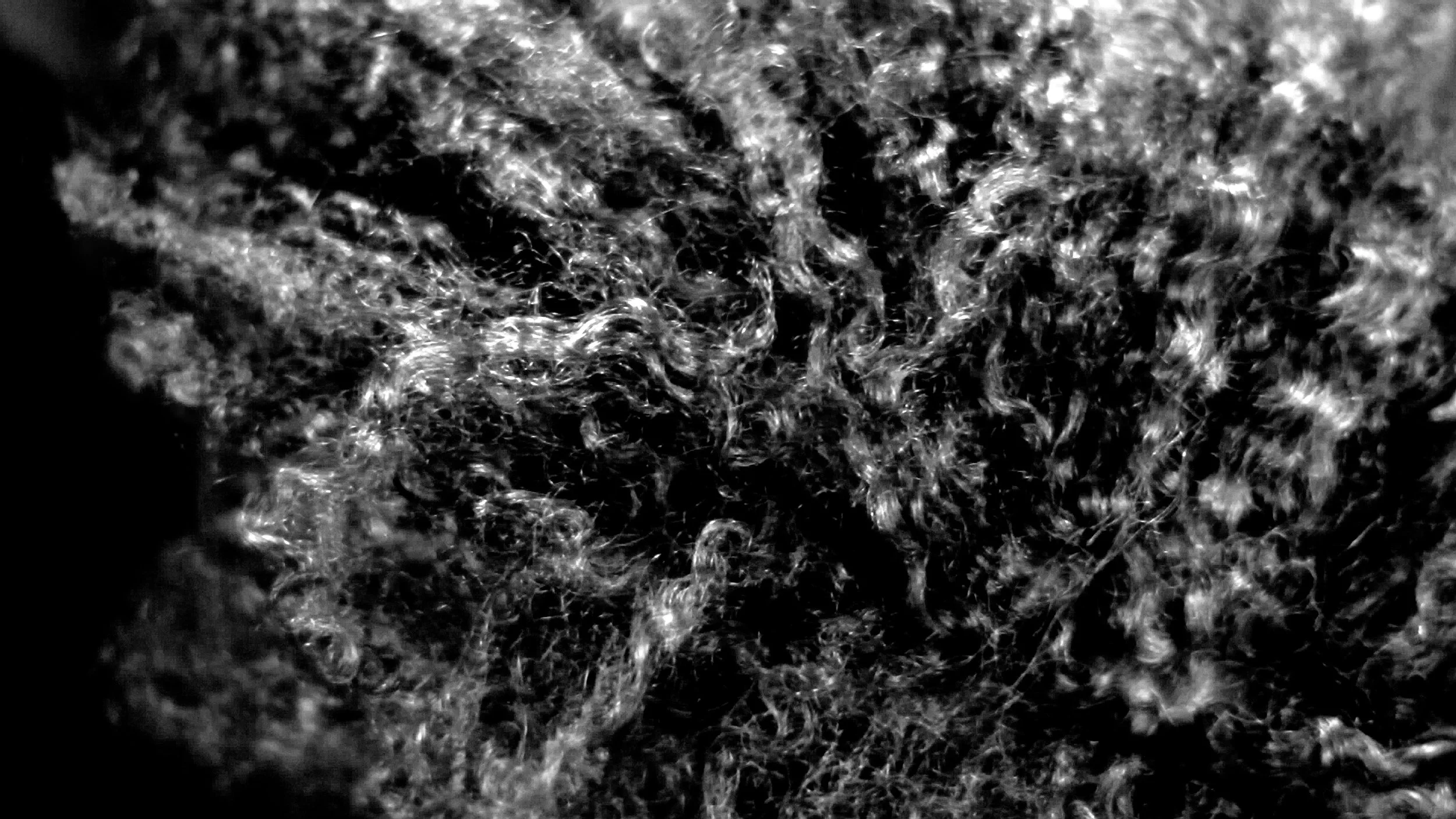
Lorraine O'Grady, Landscape (Western Hemisphere), 2010/2011. Courtesy of the Lorraine O’Grady Trust and Mariane Ibrahim (Chicago, Paris, Mexico City) © 2026 Lorraine O’Grady/Artist Rights Society (ARS), New York.
January 22 - April 30, 2027
What constitutes a landscape, and what does it mean to perceive one? Lorraine O’Grady’s video Landscape (Western Hemisphere) (2010–12) explores these questions through close-up shots of the artist’s natural, curly hair, animated by an ever-present breeze. At times, the strands resemble grass or foliage; at others, they reveal themselves as part of her body. This visual ambiguity blurs the distinction between landscape and figure, transforming an apparently expansive terrain into something intimate and embodied. The soundscape further complicates perception. Rustling grass, birds, cicadas, and passing trains are heard but never seen, encouraging viewers to imagine what exists beyond the frame. O’Grady thus suggests that landscapes are not simply objects to be passively observed but phenomena actively shaped through perception.
LOOK AGAIN: Lorraine O’Grady is the first installment of a new exhibition series developed by Phillip A. Townsend, AGBS Curator of Art, about looking slowly. The series is designed to encourage visitors to revisit the works on display throughout the course of the semester. By spending time with the art over multiple months, we have the chance to reencounter what we already know, to observe how that knowledge transforms, and to notice what we may have previously overlooked. The shifting forms and sounds of O’Grady’s video reward sustained attention and repeated viewing, making this work a fitting start to the series.
About the Artist
Lorraine O’Grady (1934-2024) was a conceptual artist and cultural critic whose work over four decades employed the diptych, or at least the diptych idea, as its primary form. While she consistently addressed issues of diaspora, hybridity and black female subjectivity and emphasized the formative roles these have played in the history of modernism, O’Grady also used the diptych’s “both/and thinking” to frame her themes as symptoms of a larger problematic, that of the divisive and hierarchical either/or categories underpinning Western philosophy. In O’Grady’s works across various genres including text, photo-installation, video and performance, multiple emotions and ideas coexist. Personal and aesthetic attitudes often considered contradictory, such as anger and joy or classicism and surrealism, are not distinguished. Even technical means seem governed by both chance and obsessive control so as to express political argument and unapologetic beauty simultaneously. And across the whole, essays and images interpenetrate. While O’Grady’s diptychs are sometimes explicit, with two images side by side, at other times they are implicit, as when two types of hair—silk and tumbleweed, videotaped on the same scalp at different hours of the same day—alternate and interact to create permeating worlds. The goal of her diptychs is not to bring about a mythic “reconciliation of opposites,” but rather to enable or even force a conversation between dissimilars long enough to induce familiarity. For O’Grady, the diptych helped to image the kind of “both/and” or “miscegenated” thinking that may be needed to counter and destabilize the
West’s either/or binary of “winners or losers,” one that is continuously birthing supremacies, from the intimate to the political, of which white supremacy may be only the most all-inclusive.
An early adopter of digital technology, O’Grady also created a website, lorraineogrady.com, which is considered a model of the online abbreviated-archive, and her paper archive is in the collection of the Wellesley College Library. Among O’Grady’s writings, the 1992/94 long-form essay “Olympia’s Maid: Reclaiming Black Female Subjectivity” has proved an enduring contribution to the fields of art history and intersectional feminism and is now considered canonical. O’Grady’s art works have been acquired by, among other institutions, the Art Institute of Chicago. IL; Museum of Modern Art, NY; Tate Modern, London, UK; Museum of Fine Arts, Boston, MA; and the Whitney Museum of American Art, NY.
Attending Programs
February 18, 2027 6 - 7 PM: Between the Seen and Unseen: A Guided Meditation
April 24, 2027 1 -3PM: Idea Lab: Open House