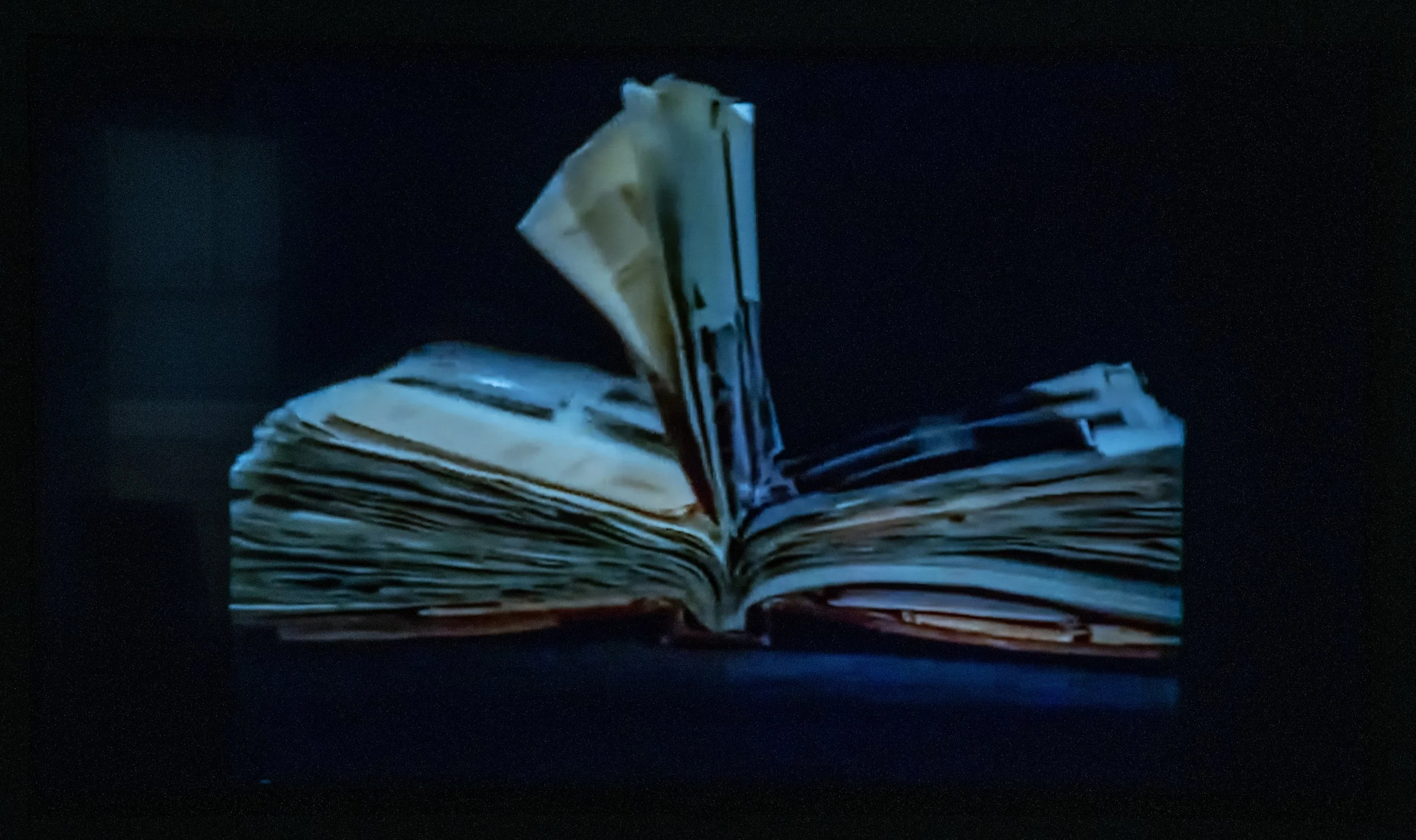
Still from Jo Spence and Nina Kellgren, Opening Up The Family Album, episode 4. BBC Channel 4, 1988. Featuring Maxine Walker, Stuart Hall, Maggie Murray, Thelma Reynolds, Sybil Phoenix, Ann Burrell and Allegra Damji.
This program brings together eight artists who, in the 1980s, embraced photography and video as means to bring visibility to the histories and perspectives of people of color, women, LGBTQ+, and/or working-class communities. Discussing how they developed new methods and ideas about photography, film, and documentary, this program illuminates the legacies of these experimental practices in contemporary art.
Convened on the occasion of the exhibition Carrie Mae Weems: Something Grander Still at the Art Galleries at Black Studies at The University of Texas at Austin, invited artists will discuss their various projects to recover then-unsung photographic histories; to rethink the politics of representation and media; and to open art and educational institutions to the large and diverse publics they serve. Delving into the connections between these artists’ efforts, this convening offers a group oral history of artworks and publications collected in AGBS’ Carrie Mae Weems: Something Grander Still.
MARCH 5, 2026 University of Texas at Austin, Art Building, Room 1.102
3-4:45 pm / Panel 1: “Photography’s New, Old Histories”
Joy Gregory and Deborah Willis converse about their work in the 1980s to build archives, books, and associations for photography of the African diaspora. Moderated by Eddie Chambers.
Refreshments to follow from 5 – 6 PM
MARCH 6, 2026 Texas State University, Wittliff Collections
1-2:45 pm / Panel 2: “Documentary in Contention”
Ben Caldwell, Janet Delaney, and Ingrid Pollard discuss the questioning of documentary taking place in the 1980s, and how this questioning was intertwined with community-building and activism. Moderated by Ariel Evans.
Intermission
3:15-5 pm / Panel 3: “Photography, Place, Position, Politics”
Marilyn Nance, Martha Rosler, and Will Wilson consider the international scope of documentary film and photography; thinking through how geopolitical concerns and increasingly global discourses about identity informed artists working in the 1980s and 1990s. Moderated by Erina Duganne.
PARTICIPANTS
Arts educator and independent filmmaker Ben Caldwell grew up assisting his grandfather, who projected movies at a small theater in New Mexico. His passion for the visual arts led him to study film at UCLA and reside in the neighborhood of Leimert Park, epicenter for the African American art scene in Los Angeles. After teaching film and video at Howard University in Washington, D.C. from 1981-84, Caldwell returned to Leimert Park and created an independent studio for video production and experimentation that became the KAOS Network, a community arts center that provides training on digital arts, media arts and multimedia. It remains the only organization of its kind in South Central Los Angeles that offers courses in video production, animation, website development, video teleconferencing, CD-ROM production and Internet exploration. Its legendary Project Blowed is a weekly open-mic workshop that gave birth to rappers and rap groups such as Aceyalone, Medusa, Busdriver, Freestyle Fellowship, and Jurassic Five.
Caldwell’s films often trace historical and cultural connections. Eyewitness: Reflections of Malcolm X & the O.A.A.U. (2006) presents the Harlem reunion of ex-members of the Organization of Afro-American Unity. La Buena Vida (The Good Life) (2008), filmed over the course of three years while Caldwell taught at the California Institute of the Arts, documents the cultural exchanges between a group of hip hop artists and musicians from Los Angeles and their counterparts in Havana, Cuba.
Janet Delaney is an American photographer known for her poignant documentation of the intersection of work, home, and shifting cityscapes. Supported by research and interviews, her projects reflect a deep engagement with the passage of time and photography's role as a historical record. Delaney gained recognition for her South of Market series, chronicling 1980s San Francisco gentrification. Her later projects, Public Matters and Red Eye to New York, captured civic life and street scenes in San Francisco and New York during the 1980s. In September of 2025 she published, Too Many Products Too Much Pressure, which looks at her family’s relationship to the business of beauty.
A 2020 Guggenheim Fellow, Delaney has received three NEA grants and held a one-year San Francisco Arts Commission residency. Her work is in major collections, including the San Francisco Museum of Modern Art, the de Young, and the High Museum and the Museum of Fine Art Houston. She earned her MFA from the San Francisco Arts Institute and held a faculty position at the University of California, Berkeley. She continues to live and work in Berkeley.
Joy Gregory is an award-winning artist specialising in photography who is known for her work concerning issues of identity politics and 'beauty' culture. A graduate of Manchester Polytechnic and the Royal College of Art she has worked and exhibited widely both in the UK and internationally participating in numerous biennales and festivals. Her work is featured in both private and public including the Victoria & Albert Museum, UK Government Art Collection, Institute of Modern Art, Brisbane, Australia and Yale University, New Haven. She is the editor of Shining Lights: Black Women Photographers in 1980s-‘90s Britain (MACK/Autograph, 2024).
Over the course of five decades, Marilyn Nance has produced images of unique moments in the cultural history of the United States and the African Diaspora. She is a two-time finalist for the W. Eugene Smith Award in Humanistic Photography. Nance’s work can be found in the collections of the Brooklyn Museum of Art, the Art Institute of Chicago, the Museum of Modern Art, the Smithsonian American Art Museum, the Schomburg Center for Research in Black Culture, the Virginia Museum of Fine Arts, and the Library of Congress and appears in innumerable publications, including The World History of Photography, History of Women in Photography, and The Black Photographers Annual.
The 2022 monograph Last Day in Lagos draws from her extensive photographic archive. The book chronicles the exuberant intensity and sociopolitical significance of the 1977 Second World Festival of Black and African Arts and Culture, an extraordinary Pan African event known as FESTAC 77, held in Lagos, Nigeria. Nance is an Honorary Fellow of the Royal Photographic Society, a worldwide community of photographers committed to bringing photography to everyone. Known for her persistence, meticulous recordkeeping, and preservation, Nance vigorously encourages others to care for their collections. Nance lives and works in Brooklyn, NY.
Ingrid Pollard MBE is a photographer, media artist and researcher who lives and works in Northumbria, UK. She is a graduate of the London College of Printing and Derby University. Pollard was part of significant collaborative ventures between black British photographers, including Polareyes, D-Max and the Association of Black Photographers (now Autograph ABP), of which she was a founding member. Pollard has developed a social practice concerned with representation, history and landscape with reference to race, difference, and the materiality of lens-based media. Pollard is an Honorary Fellow of the Royal Photographic Society and received her doctorate-by-publication from the University of Westminster in 2016. She has been the recipient of several notable awards, most recently the Royal Photographic Society’s Century Medal in 2025 and the Hasselblad Photogrpahy Award in 2024. Her work is represented in the collections of Tate Britain, the Victoria and Albert Museum, and Arts Council England. Internationally, in the collections of the Art Institute of Chicago, the Hasselblad Foundation, and Moderna Muséet in Stockholm, Sweden.
Martha Rosler's work explores the landscapes of everyday life, especially from the standpoint of women. Rosler works in a variety of media, encompassing photography, photomontage, video, performance, sculpture, installation. Through her artistic practice, her writing, and her activism, she challenges the mechanisms of power and their normalization through imagery, narrative, and discourse.
Her work mines relations between private and public spheres, the construction of gender roles, domestic labor, and consumerism. Her well-known photomontages dissect advertising’s representations of women or home life with the conduct of war abroad. Her investigations of the production and consumption of food, and its relation to gender and social status are reflected in an array of media. Her early short films on migrant farm labor in flower fields and women’s backyard labor reflect her interest in both "invisible labor" and cultural definitions of aesthetic value. Later works, like Rosler’s public garden projects in Finland and Singapore, continue to explore gender and labor in relation to urbanism.
Rosler has also organized a range of recurrent public and participatory events. Such projects include garage sales (flea markets) exploring the differential value systems in daily life and in the art world as well as the liminal role of women in bridging domestic and public economies. She has, since 1989, collaborated with communities in the US and Europe on group exhibitions and forums addressing housing, homelessness, and the built environment, most recently in 2024 in Rome. This project, "If You Lived Here...." brings together a wide array of deeply invested publics, including tenant groups, the unhoused, activists, advocates, architects, academics, public officials, and artists. Her library of over 7,000 books traveled to 7 cities in Europe and the United States, where viewers could engage a variety of these topics, among others.
Rosler has published numerous essays and several books of photographs, texts, and commentary on public space, including on gentrification and the role of artists. Her work and writing have been widely shown and published nationally and internationally. Among her national and international awards are the Spectrum International Prize in Photography, the United States Artists’ Nimoy Fellowship; the Oskar-Kokoschka Prize, the Hamburg Lichtwark Prize, a Guggenheim Museum Lifetime Achievement Award, the College Art Association Distinguished Feminist Award and the Women’s Caucus for Art Lifetime Achievement Award. Rosler has been awarded four honorary doctorates.
Rosler lives and works in Greenpoint, Brooklyn, whose urban fortunes she continues to track.
Deborah Willis, Ph.D. is University Professor and Chair of the Department of Photography & Imaging at Tisch School of the Arts at New York University where she teaches courses on Photography & Imaging, iconicity, and cultural histories visualizing the black body, women, and gender. She is the director of NYU’s Center for Black Visual Culture/Institute of African American Affairs. Her research examines photography’s multifaceted histories.
She is the author of Reflections in Black: A Reframing, The Black Civil War Soldier: A Visual History of Conflict and Citizenship and Posing Beauty: African American Images from the 1890s to the Present, among others. Dr. Willis was awarded the John D. and Catherine T. MacArthur Fellowship and was a Guggenheim Fellow among other honors.
As a photographer and installation artist, Will Wilson (Diné/Bilagaana) creates a deliberate counter narrative to romantic visions of Native people living in an unchanging past. Wilson spent his formative years living on the Navajo Nation, and his photography practice centers around the continuation and transformation of customary Indigenous cultural practice, countering the ‘archival impulse’ embedded within the historical imageries of Native peoples. Through various methods of photography, Wilson combines digital technology, historic photographic processes, performance, and installation around themes of environmental activism, the impacts of cultural and environmental change on Indigenous peoples, and the possibility of cultural survival and renewal. Wilson studied photography, sculpture, and art history at the University of New Mexico (MFA, Photography, 2002) and Oberlin College (BA, Studio Art and Art History, 1993). Wilson has been honored with the Eiteljorg Native American Fine Art Fellowship, Joan Mitchell Foundation Award for Sculpture, Pollock-Krasner Foundation Grant for Photography, and he was the Doran Artist in Residence at the Yale University Art Gallery in 2020. Wilson has held visiting professorships at the Institute of American Indian Arts, Oberlin College, and the University of Arizona. His work is exhibited and collected internationally, and he is currently Associate Professor of Studio Art in Photography and Media at the University of Texas at Austin.
MODERATORS
Eddie Chambers joined the faculty of the School of the Art Institute of Chicago in the fall 2025 semester as the Goldabelle McComb Finn Distinguished Professor in Art History, Theory, and Criticism. He was previously on the faculty of the Department of Art and Art History at the University of Texas at Austin in 2010, teaching African Diaspora art history, where he was the holder of the David Bruton, Jr. Centennial Professorship in Art History. He received his doctorate in 1998 from Goldsmiths College, University of London, awarded for his thesis ‘Black Visual Arts Activity in England Between 1981–1986: Press and Public Responses’.
He was first an artist, having graduated from art school (Sunderland Polytechnic) in 1983 with a BA (Hons) in Fine Art. His work is included in several collections including Tate Britain, Sheffield Museums, and the Arts Council Collection, London. He spent a considerable number of years as an independent curator, working with many artists including Denzil Forrester, Eugene Palmer, Tam Joseph, Frank Bowling, Permindar Kaur, and Lesley Sanderson. In addition to his exhibition work, he has written extensively about the work of modern and contemporary artists in the United Kingdom and other parts of the world. His articles, essays and peer review texts have been published in a range of magazines and journals, and he has been, for over three decades a contributor to Art Monthly (London). In June 2018 he was appointed an Art Monthly Foundation Honorary Patron, (other patrons being Liam Gillick, Hans Haacke, Mona Hatoum, Alfredo Jaar, and Martha Rosler).
Eddie Chambers has guest-edited a number of magazines and journals, including Critical Interventions, the International Review of African American Art, and several issues of Nka Journal of Contemporary African Art. The most recent issue of Nka he guest-edited was #50, published in May 2022, dedicated to subjects related to African American Artists in the International Arena.
A collection of his articles and essays, titled "Run Through the Jungle" was published by the Institute of International Visual Arts (London) as part of its ‘Annotations’ series in 1999. His book Things Done Change: The Cultural Politics of Recent Black Artists in Britain was published by Rodopi Editions, Amsterdam and New York, 2012, as part of its Cross/Cultures —Readings in the Post/Colonial Literatures in English series. He was the author of Black Artists in British Art: A History Since the 1950s, published in 2014 by I. B. Tauris/Bloomsbury, London and New York. In 2016, I. B. Tauris/Bloomsbury published his book Roots & Culture: Cultural Politics in the Making of Black Britain, a study of Black Britons’ cultural identity formations. His latest book is World is Africa: Writings on Diaspora Art, published by Bloomsbury, 2021.
He was the editor of the Routledge Companion to African American Art History, published in 2019, and the editor of the Routledge Companion to African Diaspora Art History, published in 2024. He served a three-year term as editor-in-chief of CAA's Art Journal from July 1, 2021, to June 30, 2024.
Erina Duganne is Professor of Art History at Texas State University. Her research and writing focus mostly on contemporary art and its intersection with artist activism and solidarity practices, intersectional feminisms, documentary practices, and race. She is author of The Self in Black and White: Race and Subjectivity in Postwar American Photography (2010), co-author of Global Photography: A Critical History (2020), and co-editor of Cold War Camera (2023). She served as co-curator for Beautiful Suffering: Photography and the Traffic in Pain (2006), Northern Triangle (2014), and Art for the Future: Artists Call and Central American Solidarities (2022), and as curator for Crossing Borders with Susan Meiselas and Borderland Collective (2024). Duganne’s forthcoming projects include Dreams of a Continent: Artists Call’s Transnational Solidarity with Central America, supported by The Andy Warhol Foundation Arts Writers Grant, and Feminist Visual Solidarities and Kinships, co-edited with Genevieve Hyacinthe and Susan Richmond. She is editor of the Americas for the journal Photography & Culture and co-editor for the book series Feminist Art Histories with Rutgers University Press.
Ariel Evans is a Research Fellow in the African and African Diaspora Studies Department at The University of Texas at Austin. She is the curator of the exhibition Carrie Mae Weems: Something Grander Still, at UT’s Art Galleries at Black Studies as part of her larger interests in art and photography after 1945, particularly its intersections with the politics of gender, race, and sexuality. Dr. Evans graduated with a Ph.D. from UT in 2018 and her research has been supported by the American Council of Learned Societies, Smithsonian American Art Museum, Crystal Bridges Museum of American Art, the Getty Research Institute, the Center for Creative Photography, and the Harry Ransom Center, among others. She is founding editor of the magazine Pastelegram, and has written for publications including Miranda, photographies, exposure, The Brooklyn Rail, caa.reviews, and Art in America.
This program is supported by a Curatorial Research Fellowship from the Andy Warhol Foundation for the Visual Arts, the College of Fine Arts at The University of Texas, and the Humanities Institute at The University of Texas at Austin.